Help concering understanding Circuits (Linear Algebra Related)

  • Thread starter Thread starter MMhawk607
  • Start date Start date
  • Tags Tags
    Algebra Circuits
Click For Summary
Understanding circuits in linear algebra involves applying Cramer's Rule and analyzing circuit diagrams using Kirchhoff's laws. The signs of voltage sources, such as E1 being positive and E2 negative, depend on the direction of current flow through the components. When analyzing loops, the current equations must reflect the direction of current flow, which can lead to different signs for the same resistor in different equations. Mesh analysis and Kirchhoff's methods are distinct approaches to solving circuit problems, with mesh analysis requiring one less equation than Kirchhoff's branch currents. Mastery of these concepts is crucial for effectively tackling exam questions related to circuits.
MMhawk607
Messages
5
Reaction score
0
In our Linear Algebra class we barely touched on (and I mean barely touched up on) circuits. Thing is, it will be on the exam, but just 1 question.

My problem is understanding how to get the formula to use Cramer's Rule
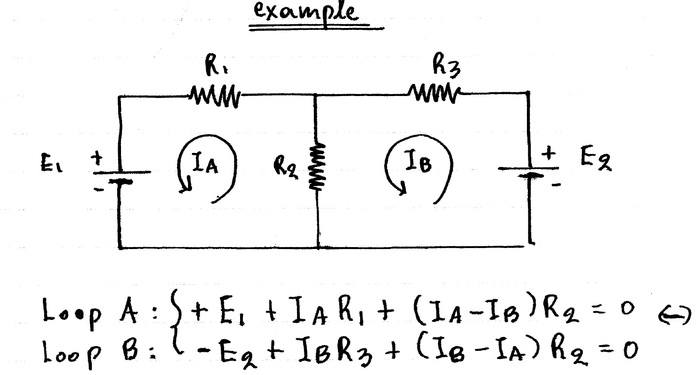
circuits.jpg


Of course I know how to set these up into Matrices and do all of that. But my issue is how do they get these formulas?

Why is E1 positive and E2 negative
Why is R2 (Ia - Ib) but on the other it's (Ib - Ia)

Any help is appreciated. I'm not asking for a problem to be solved. Just need sort of a lesson on how to read these sorts of images.
 
Engineering news on Phys.org
Hi MMhawk607! :smile:

(try using the X2 button just above the Reply box :wink:)
MMhawk607 said:
Why is E1 positive and E2 negative
Why is R2 (Ia - Ib) but on the other it's (Ib - Ia)

because you go round the same way as that round arrow is pointing

so the left arrow goes through E1 from + to -, so that's +E1,

while the right arrow goes through E2 from - to +, so that's -E2,

similarly, for the "left equation", R2 is positive, so that's R2Ia, but the left and right arrows go opposite ways through R2, so R2Ib must be negative

(you could draw the diagram with one or both of the round arrows the other way round …

then a lot of things would be minus instead of plus, but it would all give the same result in the end)
 
http://imageshack.us/a/img850/1476/kclcapture.jpg

KCL=the sum of the currents entering a node is equal to the sum of the currents leaving that node. For each loop following direction of the arrow around the loop you have drawn we get:
Loop 1: Ia=I2+Ib => I2=Ia-Ib
Loop 2: Ib=Ia+I2 => I2=Ib-Ia

Examine each loop individually(hide the part of the circuit that does not matter) so that you won't scratch your head wondering why I2 is positive in both cases...I only applied what KCL says.
i have re -drawn your image to make the above equations clear.For Loop 1 ignore red arrows. For loop 2 ignore black arrows.
 
Last edited by a moderator:
Ohhhh I see it now! Thank you guys. The professor just rushed through this part and didn't really give us time to ask questions about it. I appreciate it!
 
Hello MMHAwk, What are you studying, Physics, Maths or Elec Eng?

I ask this because you should be careful analysing the circuit as presented.

In your linear algebra class you have no doubt learned that you can transform a set of linear equations into one with a new basis. This is equivalent to directly manipulating the equations, or using matrix operations to solve them.

In linear electrical circuit theory there are several ways to analyse the system and solve a set of linear equations. They should all lead to the same solution set.
The different ways are equivalent to change of basis.

The method you have presented is Maxwells Mesh Method. This is a change of variable method, rather than a change of basis method.

Be careful not to confuse it with Kirchoff's methods, one of which mynick showed. Mesh analysis uses differnt variables and needs one les equation to solve the system compared to Kirchoff's branch currents or nodal analysis. Further it is impossible to solve a system by branch currents alone, as they do not involve voltages.

If you really wish to use Kirchoff then
 
Thread 'I thought it was only Amazon that sold unsafe junk'
I grabbed an under cabinet LED light today at a big box store. Nothing special. 18 inches in length and made to plug several lights together. Here is a pic of the power cord: The drawing on the box led me to believe that it would accept a standard IEC cord which surprised me. But it's a variation of it. I didn't try it, but I would assume you could plug a standard IEC cord into this and have a double male cord AKA suicide cord. And to boot, it's likely going to reverse the hot and...

Similar threads

  • · Replies 2 ·
Replies
2
Views
2K
Replies
68
Views
7K
  • · Replies 26 ·
Replies
26
Views
4K
  • · Replies 19 ·
Replies
19
Views
4K
  • · Replies 4 ·
Replies
4
Views
4K
  • · Replies 8 ·
Replies
8
Views
2K
Replies
3
Views
3K
Replies
12
Views
9K
  • · Replies 6 ·
Replies
6
Views
4K
Replies
12
Views
3K