HP 50g calculator's answer is correct or author's answer is correct?

Click For Summary
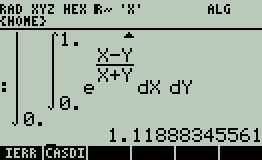
The discussion centers on evaluating the double integral of the function e^{(x-y)/(x+y)} over the triangular region defined by x ≥ 0, y ≥ 0, and x+y ≤ 1. The author claims the correct answer is (e^2 - 1)/(4e) ≈ 0.5876, while the HP 50g emulator provides a different result of approximately 1.1189. The discrepancy arises from incorrect limits of integration used in the emulator, which assumes a square region instead of the specified triangular region. The correct setup for the integral should integrate y first, leading to the proper limits of integration. This highlights the importance of accurately defining the region of integration in double integrals.
WMDhamnekar
MHB
Messages
378
Reaction score
30
Summary: Evaluate ##\displaystyle\iint\limits_R e^{\frac{x-y}{x+y}} dA ## where ##R {(x,y): x \geq 0, y \geq 0, x+y \leq 1}##

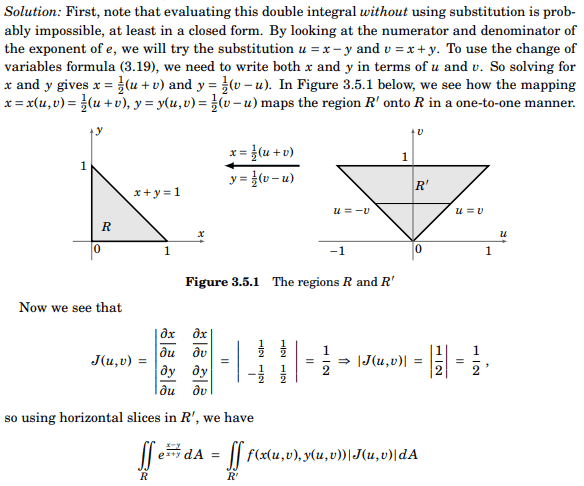
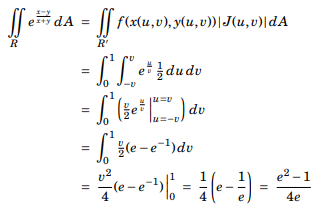
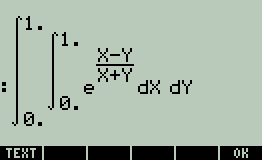
Author has given the answer to this question as ## \frac{e^2 -1}{4e} =0.587600596824 ## But hp 50g pc emulator gave the answer after more than 11 minutes of time 1.11888345561.
1653488944002.png
1653488956915.png


Author's answer
1653488974154.png


1653488990076.png
Now, How to decide which answer is correct?
 
Physics news on Phys.org
Your limits of integration are wrong on the inner integral. The integral you entered into the simulator has the region R being ##\{(x, y) | 0 \le x \le 1, 0 \le y \le 1 \}##. IOW, the square bounded by the lines x = 0, y = 0, x = 1, and y = 1. This is incorrect, since the region of integration is a triangle.

Integrating with respect to y first, your integral should look like this:
$$\int_{x=0}^1\int_{y=0}^{1 - x} e^{\frac{x-y}{x+y}}dy dx$$
 
  • Like
  • Informative
Likes Orodruin, WMDhamnekar and berkeman
Question: A clock's minute hand has length 4 and its hour hand has length 3. What is the distance between the tips at the moment when it is increasing most rapidly?(Putnam Exam Question) Answer: Making assumption that both the hands moves at constant angular velocities, the answer is ## \sqrt{7} .## But don't you think this assumption is somewhat doubtful and wrong?

Similar threads

Replies
12
Views
2K
  • · Replies 34 ·
2
Replies
34
Views
3K
Replies
5
Views
2K
Replies
9
Views
2K
  • · Replies 3 ·
Replies
3
Views
1K
Replies
20
Views
2K
  • · Replies 2 ·
Replies
2
Views
2K
  • · Replies 11 ·
Replies
11
Views
3K
  • · Replies 9 ·
Replies
9
Views
7K