Liquid rocket engine excercise

  • Thread starter Thread starter mirko9670
  • Start date Start date
  • Tags Tags
    Rockets Space
AI Thread Summary
The discussion revolves around a homework exercise focused on calculating thrust and specific impulse for a bipropellant rocket engine designed for Mars landing. The main challenge is the lack of essential parameters like exit area, throat area, and mass flow rate, which are needed to compute thrust. The exercise specifies conditions such as temperature, pressure, and gravity on Mars, along with parameters like chamber pressure and nozzle exit velocity. Participants mention resources like the Atomic Rockets website for additional information, although its scientific rigor is questioned. The conversation highlights the complexities of rocket propulsion calculations, particularly in the context of a Mars landing scenario.
mirko9670
Messages
1
Reaction score
0
Homework Statement
Find thrust and specific impulse
Relevant Equations
How can i derive the thrust? i am missing some parameters
I know it is an homework excercise but I already tried all the isoentropic relations, the problem is not the Isp, I can't find a relation to calculate the thrust as I am missing some important parameters, such as Ae, At, mdot, and thrust. This is the text of the excercise:

A bipropellant rocket engine is required for Mars landing. It will be the main engine driving the soft landing of a capsule on the martian soil to carry a scientific payload. The ground environment where the lander will operate is characterized by the following properties: Temperature: -60°C Pressure: 610 Pa Composition: mainly CO2 Acceleration due to gravity force: 3.7 m/s2

Show the formula and compute the thrust and the specific impulse for this propulsion unit if the following properties are obtained. (Assume isentropic expansion) Chamber pressure: Pc = 15 bar Exit-to-chamber nozzle pressure ratio: OPTIMAL EXPANSION Nozzle exit velocity: Ve = 2450 m/s Specific heat ratio: 1.3 Molar mass of exhaust gases: 24 g/mol
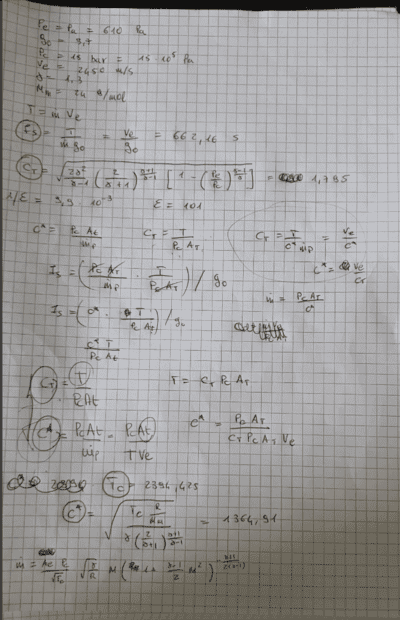
Screenshot 2024-05-10 alle 10.11.17.png
 
Physics news on Phys.org
I’m aware this is an old post but it’s still unanswered so, I’m providing this, admittedly, vague answer to the best of my abilities.

I’m assuming you mean a Nuclear Thermal Rocket.

The Atomic Rockets website on NTRs, although probably neither scientifically accurate nor rigorous, often provide links to more serious papers in the text when the host admits he’s out of his depth.

Perhaps something of value can be gleamed. I know there are lots of generic tables and nomograms.
 
Last edited:
Kindly see the attached pdf. My attempt to solve it, is in it. I'm wondering if my solution is right. My idea is this: At any point of time, the ball may be assumed to be at an incline which is at an angle of θ(kindly see both the pics in the pdf file). The value of θ will continuously change and so will the value of friction. I'm not able to figure out, why my solution is wrong, if it is wrong .
TL;DR Summary: I came across this question from a Sri Lankan A-level textbook. Question - An ice cube with a length of 10 cm is immersed in water at 0 °C. An observer observes the ice cube from the water, and it seems to be 7.75 cm long. If the refractive index of water is 4/3, find the height of the ice cube immersed in the water. I could not understand how the apparent height of the ice cube in the water depends on the height of the ice cube immersed in the water. Does anyone have an...
Thread 'A bead-mass oscillatory system problem'
I can't figure out how to find the velocity of the particle at 37 degrees. Basically the bead moves with velocity towards right let's call it v1. The particle moves with some velocity v2. In frame of the bead, the particle is performing circular motion. So v of particle wrt bead would be perpendicular to the string. But how would I find the velocity of particle in ground frame? I tried using vectors to figure it out and the angle is coming out to be extremely long. One equation is by work...
Back
Top