Boom Angle of Crane: Is High Extension Necessary?

  • Thread starter Thread starter DaveC426913
  • Start date Start date
  • Tags Tags
    Angle Crane
Click For Summary
High extension of crane booms in boat hauling is primarily for safety and maneuverability, allowing ground crews to adjust the boat's position with less restoring force due to gravity. Longer suspension wires reduce the angle of deflection, minimizing the force exerted on the crane. Composite booms require full extension to achieve rigidity and support side forces, a design philosophy now adopted by steel booms to enhance performance. The boom angle is managed by an onboard computer, ensuring safe operation within designated limits. Overall, the high extension is crucial for effective and safe boat handling.
DaveC426913
Gold Member
Messages
24,120
Reaction score
8,254
TL;DR
Is there a reason why a boom crane operator would extend the boom higher than physically necessary?
These boat hauling cranes seem to extend their booms as high as possible. Much higher than necessary for the max height of the boat lifting rig.

Does this accomplish something effort or safety-wise?

It's not like a simple torque situation - the force applied is gravity - straight down - not perpendicular to the boom as it might be in a simple setup.
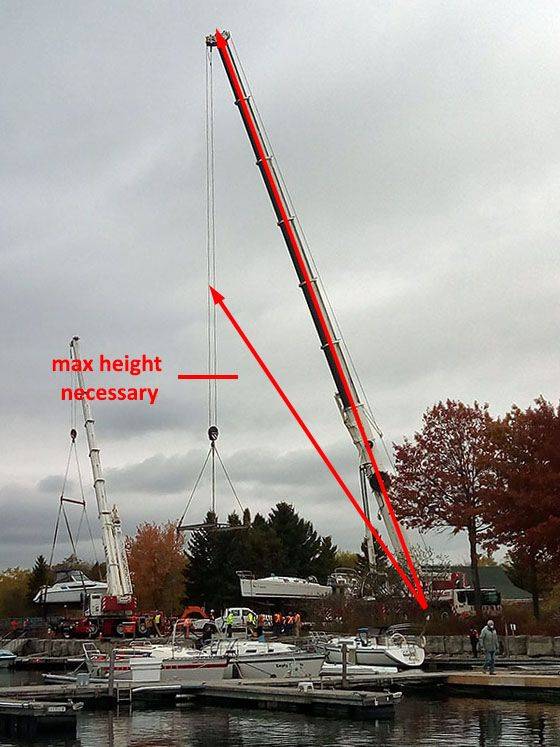
crane.jpg
 
Engineering news on Phys.org
It would make manoevring the boat easier for the ground crew.
 
tech99 said:
It would make manoevring the boat easier for the ground crew.
Why/how?
 
It is possible for the ground crew to move the boat around to a limited extent, which pulls the suspension wire out of vertical. When they do this, there is a restoring force equal to Weight x Sin (angle of deflection).
If the wire is very long, the angle of deflection is smaller, so the restoring force is less.
For example, a boat weighs 1t and the wire is 2 degs out of vertical. Restoring force = 1 x sin 2 = 0.03t.
By the same token, if the wire is 20m long, then the boat has been moved by 20 sin 2 = 0.7m.
 
  • Informative
  • Like
Likes Lnewqban and berkeman
Another factor, how high can that boat get before it could hit the boom if it pivots?
 
When they began to build booms from composites, rather than the heavy and difficult to work HT steel, all the sections were extended by an internal tensile wire. The boom had no real strength while being extended as the composite tube walls were too light to carry a large moment at part extension. The composite sections must be fully extended for the tube ends (where there are a pair of internal pulleys) to lock, and so become rigid, and able to carry a side force. The telescopic tubes are under compression, the wire is under tension.

I believe that steel booms are now designed using the same philosophy, as they must compete with composite booms. So, now all booms are operated fully extended.

The boom angle is controlled, and the safe operating envelope managed by a dedicated on-board computer, to prevent the operator from "taking the crane out-of-survey", to put it nicely.
 
  • Informative
  • Like
Likes Dullard, berkeman and anorlunda
What mathematics software should engineering students use? Is it correct that much of the engineering industry relies on MATLAB, making it the tool many graduates will encounter in professional settings? How does SageMath compare? It is a free package that supports both numerical and symbolic computation and can be installed on various platforms. Could it become more widely used because it is freely available? I am an academic who has taught engineering mathematics, and taught the...

Similar threads

  • · Replies 1 ·
Replies
1
Views
2K
  • · Replies 1 ·
Replies
1
Views
3K
  • · Replies 27 ·
Replies
27
Views
10K
  • · Replies 7 ·
Replies
7
Views
3K
  • · Replies 1 ·
Replies
1
Views
2K
  • · Replies 4 ·
Replies
4
Views
7K
  • · Replies 1 ·
Replies
1
Views
4K
  • · Replies 6 ·
Replies
6
Views
3K
  • · Replies 12 ·
Replies
12
Views
5K
  • · Replies 1 ·
Replies
1
Views
4K