Do communicating vessels work when water is moving?

  • Thread starter Thread starter r6900
  • Start date Start date
  • Tags Tags
    Water Work
Click For Summary
Water levels in communicating vessels will equalize regardless of movement, as long as the connection between them remains intact. A vortex can form in one vessel, but it requires a flow of water, typically through an opening. The discussion highlights that a vortex cannot exist in a closed system without an outlet. If an engine is introduced into the water, it can create a vortex, but this does not affect the principle of equalization in communicating vessels. Ultimately, the water levels will stabilize at the same height despite the presence of a vortex.
r6900
Messages
2
Reaction score
0
Hi
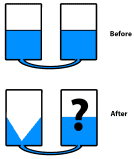
I want to know if the water level equalize in communicating vessels, when in one of the vessels there is a vortex, or any other water movement, and if the level does equalize, what will be the level?
I made a simple drawing:
2re1386.png

Here's a link for full size:
http://i49.tinypic.com/2gsn85h.jpg

Thanks!
 
Physics news on Phys.org
r6900, Welcome to Physics Forums!

From the diagram it appears that the lower left container is shown as “having a vortex”. But that can’t be, because in order for a vortex to form the liquid needs to be flowing out through an opening (like a bathtub drain). The diagram shows only a tube connecting the two containers, so I can’t visualize any flow to maintain that vortex.

Cheers,
Bobbywhy
 
Bobbywhy said:
r6900, Welcome to Physics Forums!

From the diagram it appears that the lower left container is shown as “having a vortex”. But that can’t be, because in order for a vortex to form the liquid needs to be flowing out through an opening (like a bathtub drain). The diagram shows only a tube connecting the two containers, so I can’t visualize any flow to maintain that vortex.

Cheers,
Bobbywhy

If you put an engine inside the water it creates a vortex.
 
For simple comparison, I think the same thought process can be followed as a block slides down a hill, - for block down hill, simple starting PE of mgh to final max KE 0.5mv^2 - comparing PE1 to max KE2 would result in finding the work friction did through the process. efficiency is just 100*KE2/PE1. If a mousetrap car travels along a flat surface, a starting PE of 0.5 k th^2 can be measured and maximum velocity of the car can also be measured. If energy efficiency is defined by...

Similar threads

  • · Replies 4 ·
Replies
4
Views
1K
  • · Replies 17 ·
Replies
17
Views
5K
Replies
8
Views
2K
  • · Replies 13 ·
Replies
13
Views
3K
Replies
3
Views
5K
  • · Replies 32 ·
2
Replies
32
Views
10K
Replies
4
Views
3K
  • · Replies 11 ·
Replies
11
Views
4K
Replies
8
Views
4K
  • · Replies 8 ·
Replies
8
Views
3K