Help Identifying AESA Antenna Structure Type found in the F-35 aircraft

Click For Summary

Discussion Overview

The discussion revolves around identifying the structural layout of the AN/APG-81 AESA Radar antenna used in the F-35 aircraft. Participants explore various antenna designs, comparing the APG-81 to previous models like the APG-68 from the F-16 and the APG-77 from the F-22. The conversation includes technical details about antenna structures and their functionalities.

Discussion Character

  • Technical explanation
  • Debate/contested
  • Exploratory

Main Points Raised

  • One participant notes that the APG-81 has a different structure compared to past AESA/PESA antennas, suggesting it may resemble a "honeycomb" layout, although this term lacks scholarly references.
  • Another participant proposes that the antenna could be a Vivaldi Slot Array, but later points out that the slots appear to be of uniform width rather than tapered, which is typical for Vivaldi designs.
  • Some participants discuss the presence of slotted waveguides in the APG-81, highlighting the offset of the slots as a characteristic feature.
  • There is speculation about the elements on the periphery possibly being parasitic elements, with uncertainty about the metallization visible in the images.
  • A participant mentions that the antenna operates around 10GHz, with individual radiator dimensions suggested to be approximately 1.4cm, and discusses how these radiators may be driven to direct the beam.
  • Comparative analysis is made with the APG-77 from the F-22, noting differences in the radiator shapes and materials used.
  • One participant expresses a personal interest in the technology and mentions having a phased array from a terrestrial microwave link antenna that they find difficult to understand.

Areas of Agreement / Disagreement

Participants express various hypotheses and suggestions regarding the structure of the APG-81 antenna, but no consensus is reached on its exact classification or terminology. Multiple competing views remain regarding the antenna's design and functionality.

Contextual Notes

Participants reference images and videos to support their claims, but limitations in visibility and detail from the provided pictures may affect the accuracy of their assessments. The discussion also reflects a reliance on specific measurements and assumptions about the antenna's design.
ryaamaak
Messages
16
Reaction score
11
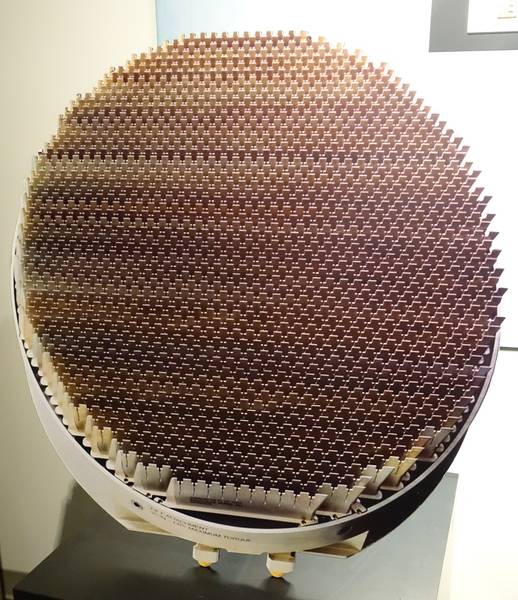
This is the AN/APG-81 AESA Radar antenna by Northrop Grumman currently found in the F-35 (photo from wikipedia article).
AN-APG-81_Antenna%2C_2005_-_National_Electronics_Museum_-_DSC00393.jpg

It seems to have a very different structure than past AESA/PESA antennas. For example the APG-68 from the F-16 looks a lot like stacked, slotted wave guides to me.

So what is the name of the actual structural layout for the APG-81? One person I talked to suggested "honeycomb", but I couldn't find any reference to that antenna structure on google scholar. Better search terms would be appreciated. :)

Thanks!
 

Attachments

  • AN-APG-81_Antenna%2C_2005_-_National_Electronics_Museum_-_DSC00393.jpg
    AN-APG-81_Antenna%2C_2005_-_National_Electronics_Museum_-_DSC00393.jpg
    73.1 KB · Views: 2,571
Last edited by a moderator:
  • Like
Likes   Reactions: davenn and berkeman
Engineering news on Phys.org
Paul Colby said:
but I was going to suggest a Vivaldi Slot Array.

good thought, except Vivaldi slots are usually tapered, on closer inspection, these slots are a uniform width

ryaamaak said:
...
It seems to have a very different structure than past AESA/PESA antennas. For example the APG-68 from the F-16 looks a lot like stacked, slotted wave guides to me...
Thanks!

Yes, that antenna definitely appears to be sets of slotted waveguides, a big giveaway is the offset of the slots along each guide
that is the norm. for slotted WG's

do you have a link to a larger pic of this antenna ?

youtube video from Northrop Grumman for the radar
other videos on the topic ...


Dave
 
Last edited:
  • Like
Likes   Reactions: ryaamaak
davenn said:
good thought, except Vivaldi slots are usually tapered, on closer inspection, these slots are a uniform width

The elements on the periphery may be parasitic elements. It's unclear to me if the metallization is seen. It may be on the side facing away in the picture. I'm happy for it not to be one though.
 
  • Like
Likes   Reactions: ryaamaak
Thanks everyone for the great input!

davenn said:
do you have a link to a larger pic of this antenna ?
Larger image may be found here. I wasn't able to embed it full size.
 
  • Like
Likes   Reactions: davenn
ryaamaak said:
Thanks everyone for the great input!

Larger image may be found here. I wasn't able to embed it full size.

yeah, I eventually found that in the wiki article when I was looking through those other links I posted :smile:

here's a closeup of a section

10GHz radar phased array antenna.jpg


This antenna is designed for around 10GHz plus/minus ~ 1GHz
I suspect each of those little bars at the top is a 1/4 or 1/2 wave at 10GHz (electrical 1/2 wave = ~ 1.4cm)
A tad difficult to tell the scale in that image
So basically you have masses of say 1/4 wave radiators and the rows of these radiators can be driven by the transmitter
in and out of phase to direct the beam as needed ... as shown in that 2nd or 3rd video I posted

a hint to how these radiators are grouped comes from a bit of that first video shortly in from the startDave
 

Attachments

  • 10GHz radar phased array antenna.jpg
    10GHz radar phased array antenna.jpg
    44.9 KB · Views: 2,133
  • Like
Likes   Reactions: ryaamaak
On a similar theme

I have a phased array from a terrestrial microwave link antenna that I have had a difficult time to
understand the technology and how the heck it radiates/receives
I may post a pic when I get home fort your interest :smile:

Dave
 
  • Like
Likes   Reactions: ryaamaak
Ok I think I'm getting the gist of it. One article mentioned a diameter of approximately 0.7m for the APG-81, so an individual measurement of ~1.4cm seems plausible. Forgive me if this question has a self-evident answer, but would this radiator shape have a specific name or descriptive terms attached to it? (I'm thinking along the lines of how "dipole antenna" shaped elements are frequently used as passive radiators in a yagi-uda antenna.)

For comparison/contrast, the APG-77 from the F22 (below) has a similar structure to the APG-81, but the individual radiators are slightly different: not as tapered at the top, no deep slit between radiators, and confirmed use of GaAs.

lectronically_Scanned_Array%2C_Northrop_Grumman%2C_2001_-_National_Electronics_Museum_-_DSC00388.jpg


Thanks!
 

Attachments

  • lectronically_Scanned_Array%2C_Northrop_Grumman%2C_2001_-_National_Electronics_Museum_-_DSC00388.jpg
    lectronically_Scanned_Array%2C_Northrop_Grumman%2C_2001_-_National_Electronics_Museum_-_DSC00388.jpg
    55.2 KB · Views: 2,127
  • Like
Likes   Reactions: davenn
ryaamaak said:
Ok I think I'm getting the gist of it. One article mentioned a diameter of approximately 0.7m for the APG-81, so an individual measurement of ~1.4cm seems plausible. Forgive me if this question has a self-evident answer, but would this radiator shape have a specific name or descriptive terms attached to it? (I'm thinking along the lines of how "dipole antenna" shaped elements are frequently used as passive radiators in a yagi-uda antenna.)

For comparison/contrast, the APG-77 from the F22 (below) has a similar structure to the APG-81, but the individual radiators are slightly different: not as tapered at the top, no deep slit between radiators, and confirmed use of GaAs.

View attachment 225104

Thanks!
that's a cool variation

ryaamaak said:
For comparison/contrast, the APG-77 from the F22 (below) has a similar structure to the APG-81, but the individual radiators are slightly different: not as tapered at the top, no deep slit between radiators

not as deep as the other one but deeper than initially thought on first look see this ...

10GHz radar phased array antenna2.jpg


upload_2018-5-4_14-15-15.png


they have the same stepped arrangement

I'm a radio tech at heart, this sort of high tech fascinates the hell out of me haha
 

Attachments

  • 10GHz radar phased array antenna2.jpg
    10GHz radar phased array antenna2.jpg
    28.9 KB · Views: 1,772
  • upload_2018-5-4_14-15-15.png
    upload_2018-5-4_14-15-15.png
    38 KB · Views: 1,628
  • Like
Likes   Reactions: ryaamaak
  • #10
Now @Paul Colby earlier commented on Vivaldi antennas

Paul Colby said:
I can't see much detail from the picture but I was going to suggest a Vivaldi Slot Array. https://pdfs.semanticscholar.org/9fe2/60de5caeec3cdc36cbb2dbea50e7b5f2fc53.pdf

just stumbled on this pic of a real Vivaldi phased array for a radar
Note how the slot changes from wide to narrow aperture ... this gives it wide bandwidth

10GHz radar phased array antenna3.jpg


going further

here's the block diag. of the feeding of the Vivaldi on the left and our other type on the right

AESA_1.png
Dave
 

Attachments

  • 10GHz radar phased array antenna3.jpg
    10GHz radar phased array antenna3.jpg
    62.6 KB · Views: 3,287
  • AESA_1.png
    AESA_1.png
    2.9 KB · Views: 2,076
  • Like
Likes   Reactions: ryaamaak and Paul Colby