miniz88
- 2
- 0
I am in no way trying to ask you to do this problem for me, i just need a little guidance, like where do i start and i feel like i should be able to figure out the rest. My textbook uses examples but when i the questions come up it looks completely different so i don't know where to start.
A mountain-climbing expedition establishes two intermediate camps, labeled A and B in the drawing, above the base camp. What is the magnitude r of the displacement between camp A and camp B?
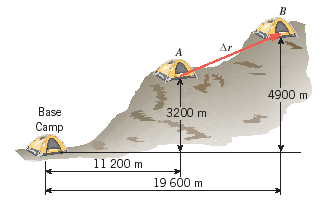
My thoughts about the question were (its hard to explain except on paper but ill try to show you what i thought to do): Displacement = (triangle)R = r - r(sub 0). I assumed that the distance from camp A and B is 8400 ( (Base Camp to camp B) - (Base Camp to Camp A). Then i made a line from the bottom point of the line under camp A diagonally up to camp B and that is the r(sub 0) line. I used a^2+b^2=c^2 to find out that r(sub 0) is 9724.71 and then i used 3200m as r and i did r - r(sub 0) = 6524.71 meters. But i have not clue if i did any of that right?? If you could let me know i would appreciate it.
A mountain-climbing expedition establishes two intermediate camps, labeled A and B in the drawing, above the base camp. What is the magnitude r of the displacement between camp A and camp B?
My thoughts about the question were (its hard to explain except on paper but ill try to show you what i thought to do): Displacement = (triangle)R = r - r(sub 0). I assumed that the distance from camp A and B is 8400 ( (Base Camp to camp B) - (Base Camp to Camp A). Then i made a line from the bottom point of the line under camp A diagonally up to camp B and that is the r(sub 0) line. I used a^2+b^2=c^2 to find out that r(sub 0) is 9724.71 and then i used 3200m as r and i did r - r(sub 0) = 6524.71 meters. But i have not clue if i did any of that right?? If you could let me know i would appreciate it.