Rearranging an SUVAT Equation: Solving for Time

Click For Summary
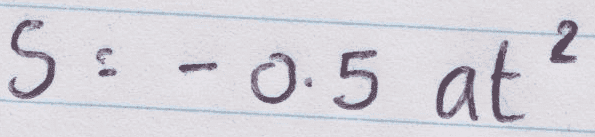
The discussion focuses on rearranging the SUVAT equation to solve for time (t). A user seeks assistance with their algebra skills, specifically in handling the equation s = -0.5at². Responses emphasize the importance of understanding that 0.5 is a factor rather than a term to be added or subtracted. The conversation highlights the need for a solid grasp of basic algebra when working with physics equations. Overall, the community offers support and guidance in revisiting foundational concepts.
Physics55555
Messages
2
Reaction score
0
Hello everyone,

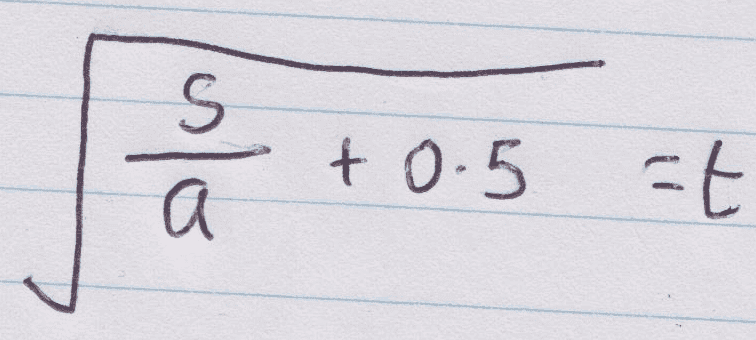
Please can someone help me rearrange this equation to make t the subject:
upload_2016-4-18_18-35-35.png
Relevant equations:
upload_2016-4-18_18-35-45.png
My attempt at a solution:
upload_2016-4-18_18-36-25.png


Thank you all for you help
 
Physics news on Phys.org
Physics55555 said:
Hello everyone,

Please can someone help me rearrange this equation to make t the subject:

View attachment 99318

Relevant equations:
View attachment 99319
My attempt at a solution:
View attachment 99320

Thank you all for you help
Not such good Algebra.
0.5 is a factor. It's not added or subtracted.

You start with
##s=-\frac12 at^2 ##

Multiply both sides by ##\displaystyle \ -\frac2a\ ##
 
You probably should take a few minutes to review basic algebra before going any further with physics. :wink:
 
lol, thanks guys. It's been years since I've done this kind of stuff! I've totally forgotten what to do when there's a negative number involved.

Appreciate the help @SammyS and @SteamKing
 
Physics55555 said:
lol, thanks guys. It's been years since I've done this kind of stuff! I've totally forgotten what to do when there's a negative number involved.

Appreciate the help @SammyS and @SteamKing
You're welcome.

It's more a matter that the numbers are all multiplied, rather than that there is a negative.
 
The book claims the answer is that all the magnitudes are the same because "the gravitational force on the penguin is the same". I'm having trouble understanding this. I thought the buoyant force was equal to the weight of the fluid displaced. Weight depends on mass which depends on density. Therefore, due to the differing densities the buoyant force will be different in each case? Is this incorrect?

Similar threads

  • · Replies 44 ·
2
Replies
44
Views
4K
Replies
5
Views
7K
Replies
25
Views
2K
  • · Replies 10 ·
Replies
10
Views
3K
  • · Replies 98 ·
4
Replies
98
Views
6K
  • · Replies 8 ·
Replies
8
Views
2K
  • · Replies 13 ·
Replies
13
Views
2K
  • · Replies 11 ·
Replies
11
Views
1K
  • · Replies 1 ·
Replies
1
Views
3K